

VENUS: VALENTINO GARAVANI THROUGH THE EYES OF JOANA VASCONCELOS

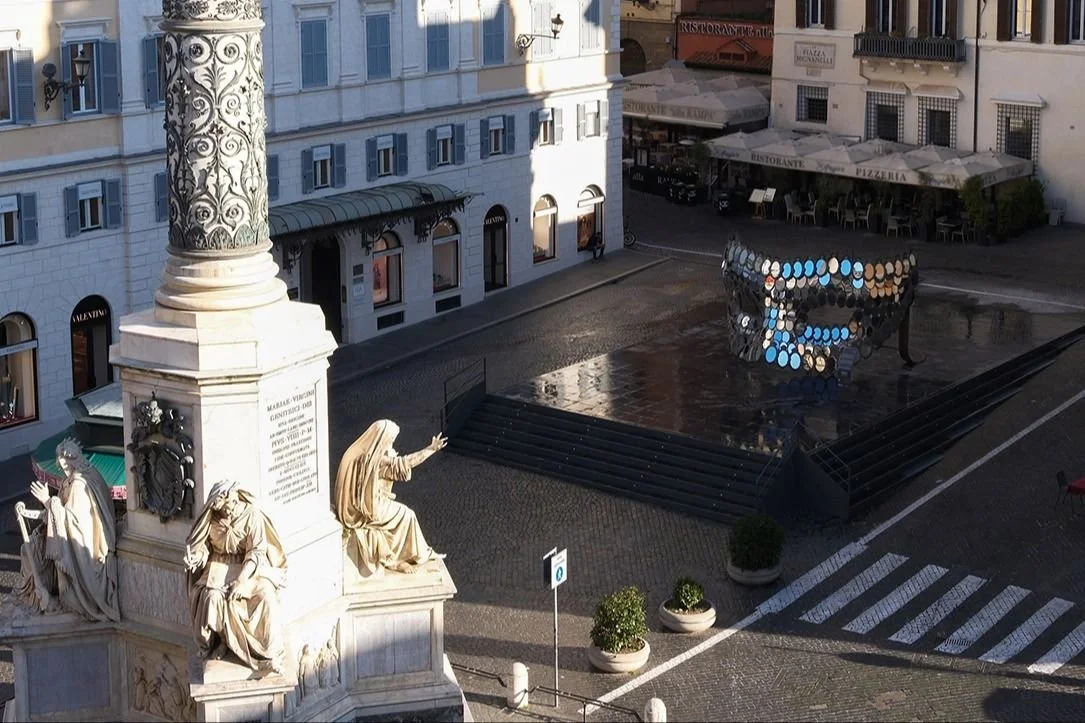
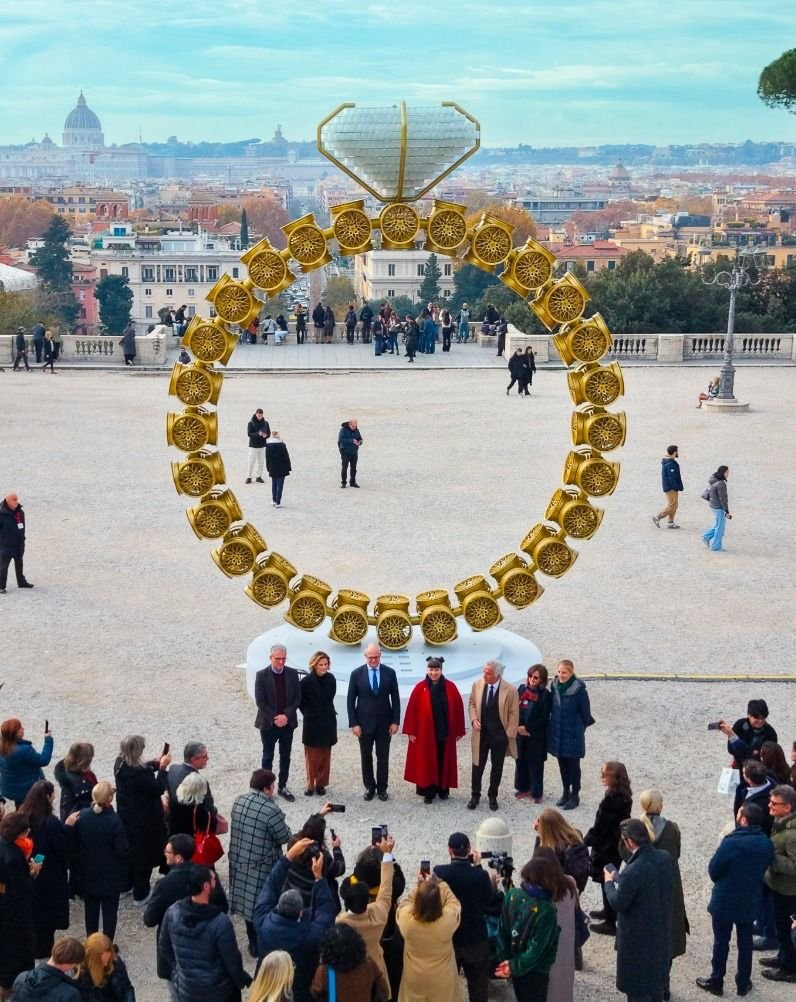
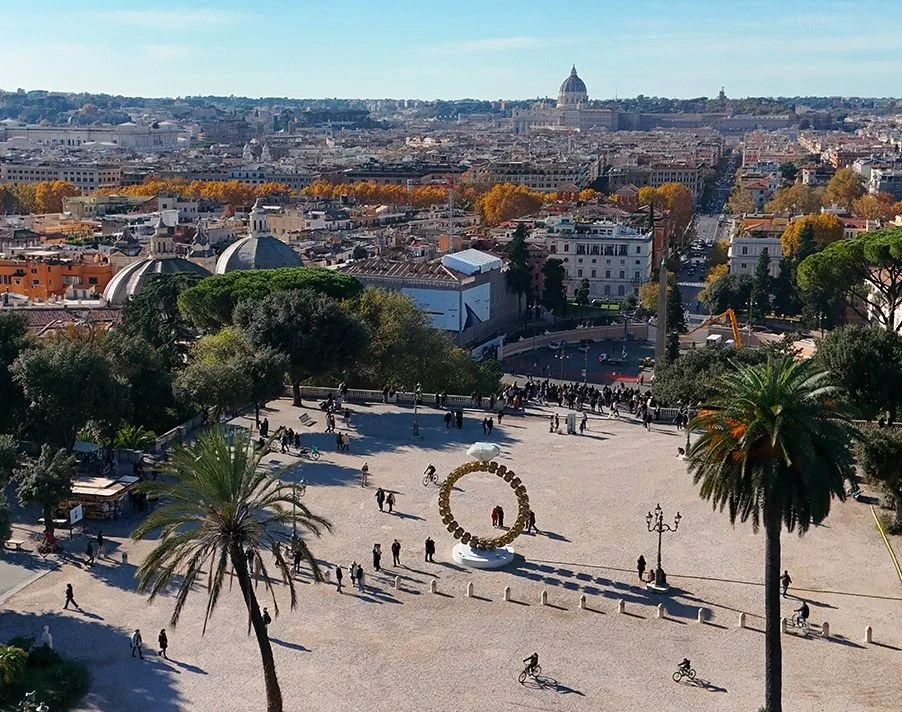
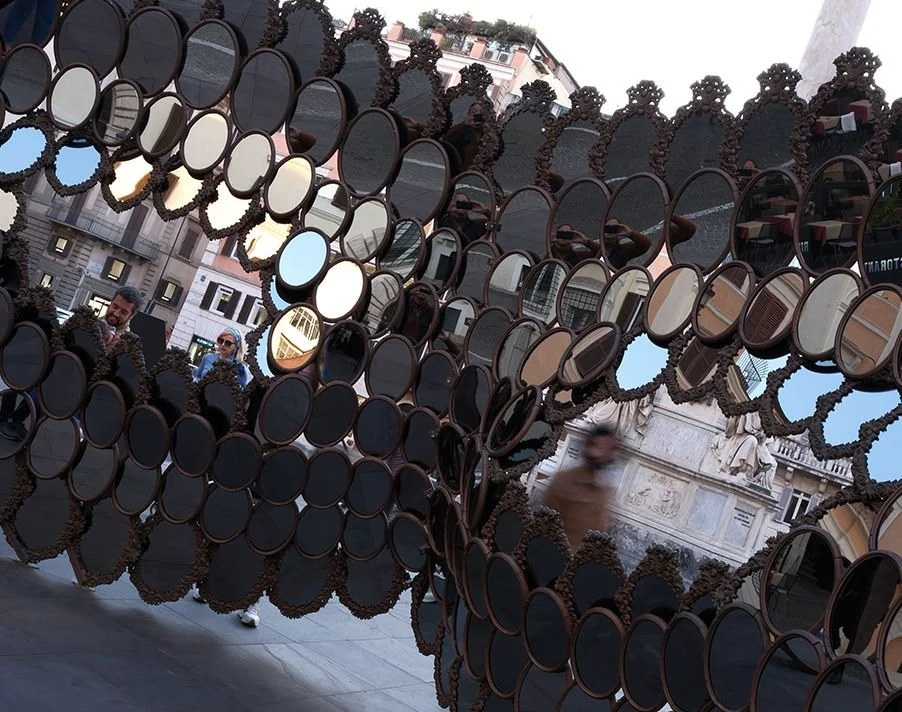
In the quiet gravity of Piazza Mignanelli, just steps from the iconic Piazza di Spagna, a new cultural chapter unfolds—one that reframes beauty not as ornament, but as action. With VENUS: Valentino Garavani through the eyes of Joana Vasconcelos, PM23 emerges as both a physical space and an evolving philosophy: a place where art, fashion, and social consciousness intersect to generate dialogue, transformation, and collective meaning.
Imagined by Valentino Garavani and Giancarlo Giammetti, PM23 represents more than an exhibition venue. It is a renewed commitment to Rome itself—a gift to the city that positions beauty as a living force, capable of shaping identity, fostering connection, and advancing social progress. Within this intimate Roman setting, Joana Vasconcelos presents a non-linear, immersive journey that draws from Valentino Garavani’s legacy while expanding it into new conceptual and communal dimensions.
At the heart of the exhibition stands VENUS, a monumental Valkyrie-like figure that does not replicate haute couture, but converses with it. Through abstraction, Vasconcelos reinterprets garments, silhouettes, and textile surfaces, translating couture’s discipline—its precision, hierarchy, and reverence for craft—into a sculptural language that feels both ancient and urgently contemporary. VENUS is not a muse; she is a heroine. A symbol of power, protection, and resilience, she embodies the strength of collective creation and the dignity of human labour.
For Vasconcelos, this project is rooted in dialogue rather than homage. Her work and Valentino Garavani’s vision meet in a suspended moment of shared belief: that beauty generates harmony, and harmony holds the promise of peace and social justice. In a world fractured by division, VENUS offers an alternative narrative—one where art becomes a connective tissue rather than a singular statement.
What distinguishes this exhibition is not only its scale, but its process. Conceived by the artist and realized through an extraordinary participatory framework, VENUS was created by thousands of hands across Rome. Over 756 hours of workshops, more than 200 participants—students, patients, refugees, survivors of violence, incarcerated women, and families—contributed crocheted elements that ultimately converged into a single sculptural form. These fragments, made across neighbourhoods and social realities, were gathered and assembled in Vasconcelos’s Lisbon studio, transforming individual gestures into a unified artistic presence.
The collaborators span institutions and communities often kept separate: students from Rome’s leading fashion and art academies; young patients at Ospedale Bambino Gesù; end-of-life patients at Gemelli Medical Center; women from INTERSOS refugee shelters and Differenza Donna; and female inmates at Rebibbia Prison. Through this cross-pollination of spaces and stories, the project fostered unexpected connections, shared authorship, and a redefinition of artistic value—not as exclusivity, but as participation.
VENUS thus becomes an ambassador of our time: a manifestation of collaborative intelligence, reclaimed identity, and quiet resistance. Each crocheted piece carries the imprint of care, skill, and lived experience, transforming traditional craft into a vehicle for empowerment and emancipation. Here, know-how is not merely preserved—it is transmitted, shared, and re-signified as a form of social vitality.
In this context, PM23 asserts itself as a living organism rather than a static institution. It is a space where beauty is not simply contemplated, but circulated—where fashion and art meet to generate culture, inspire dialogue, and imagine new collective horizons. Sponsored by the Department of Culture and created in collaboration with Municipio I Roma Centro, the exhibition aligns artistic excellence with civic responsibility.
VENUS ultimately asks a profound question: what happens when beauty is shared? The answer unfolds not only in form, but in process—in the hands that made it, the stories embedded within it, and the communities it brings into view. Through Joana Vasconcelos’s lens, Valentino Garavani’s legacy is not frozen in reverence, but expanded into a living, breathing act of solidarity.