

MARINE SERRE X LOUVRE
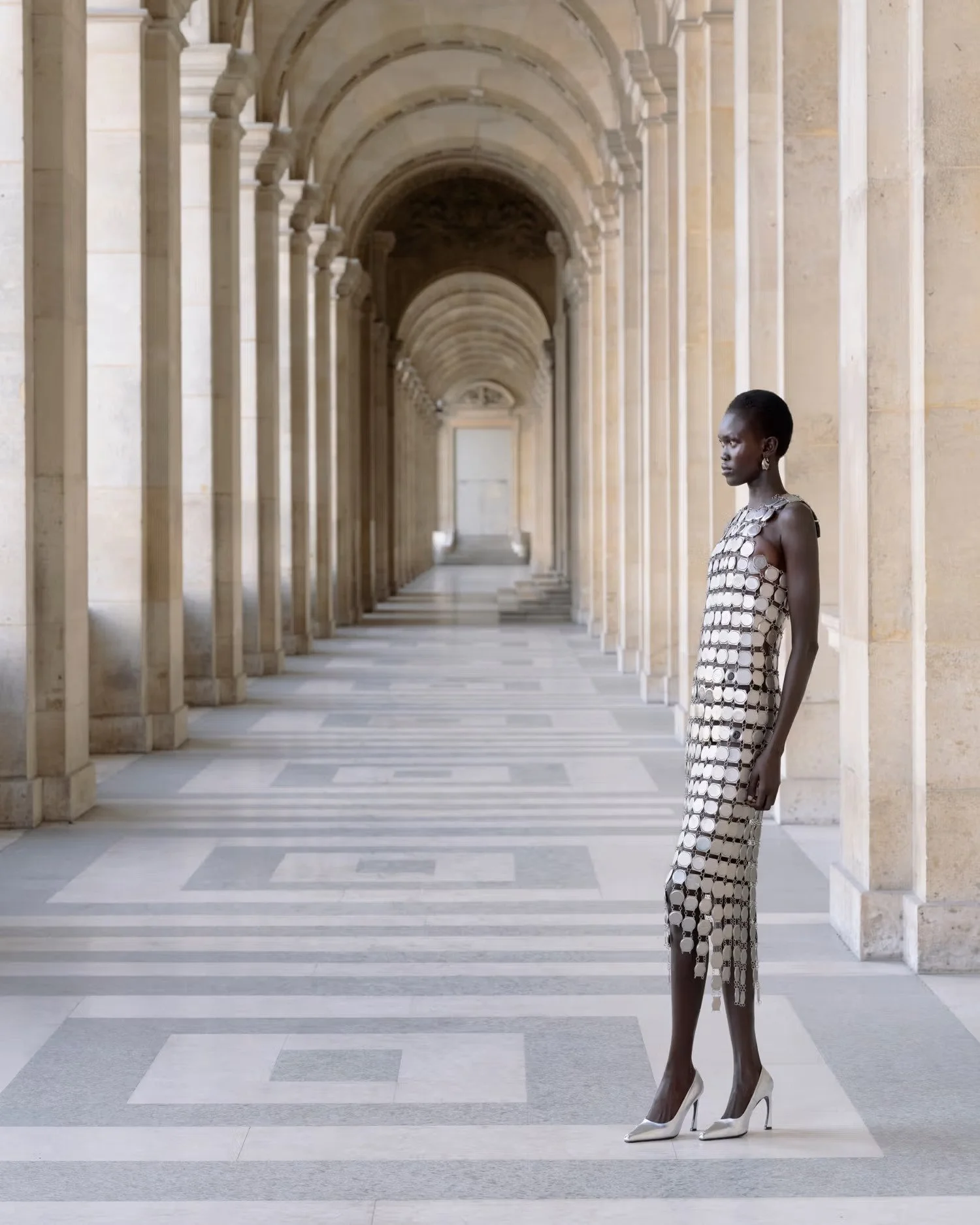
Marine Serre has never treated fashion as a surface. For the Paris-based designer, clothing is a system of memory: a place where symbols, histories, discarded materials and future visions can be reconstructed into something radically alive. Her collaboration with the Louvre extends that language into one of the world’s most iconic cultural institutions, transforming the museum not simply into a reference point, but into a working archive for contemporary couture.
The Louvre has long existed as a universe of forms for Marine Serre: a matrix of myths, gestures, icons and visual codes that continue to echo through the present. In this project, that relationship becomes tangible. The collaboration brings together the museum and the workshop, the painter’s hand and the couturier’s eye, the historical object and the moving body. It is not nostalgia. It is reconstruction.
Rather than approaching the Louvre as a static monument, Marine Serre reimagines it as a living source. Paintings, studio objects, artist clichés and fragments of visual history are pulled out of their expected contexts and reworked through the House’s signature language of regeneration. The result is a series of couture creations that feel both archival and immediate: garments that carry the weight of history while insisting on movement, use and transformation.
The Artist at Work, Reimagined
Across five couture looks, Marine Serre plays with the familiar mythology of the artist: the painter in the studio, the model, the brush, the paint tube, the worn shirt, the sacred masterpiece. But instead of preserving these symbols in their traditional roles, she mischievously disrupts them. The tools of art-making become the materials of fashion-making.
Paintbrushes are no longer accessories to creation; they become part of the garment. Paint tubes are not discarded studio remnants; they are reconstructed into sculptural couture. The painter’s shirt becomes a sign of labour, intimacy and transformation. In Serre’s hands, the artist’s world is not merely represented. It is dismantled and rebuilt.
This is where the collaboration feels most aligned with Marine Serre’s broader practice. Her work has consistently challenged ideas of luxury by foregrounding upcycling, circularity and the creative potential of existing materials. With the Louvre, that philosophy moves into a deeper historical register. The fragments are not only material; they are cultural. Heritage itself becomes something to be cut, shaped, embroidered and worn.
Five Looks, Five Living Archives
The Marine Serre x Louvre project unfolds through five couture creations, each one operating as a dialogue between art history and contemporary fashion.
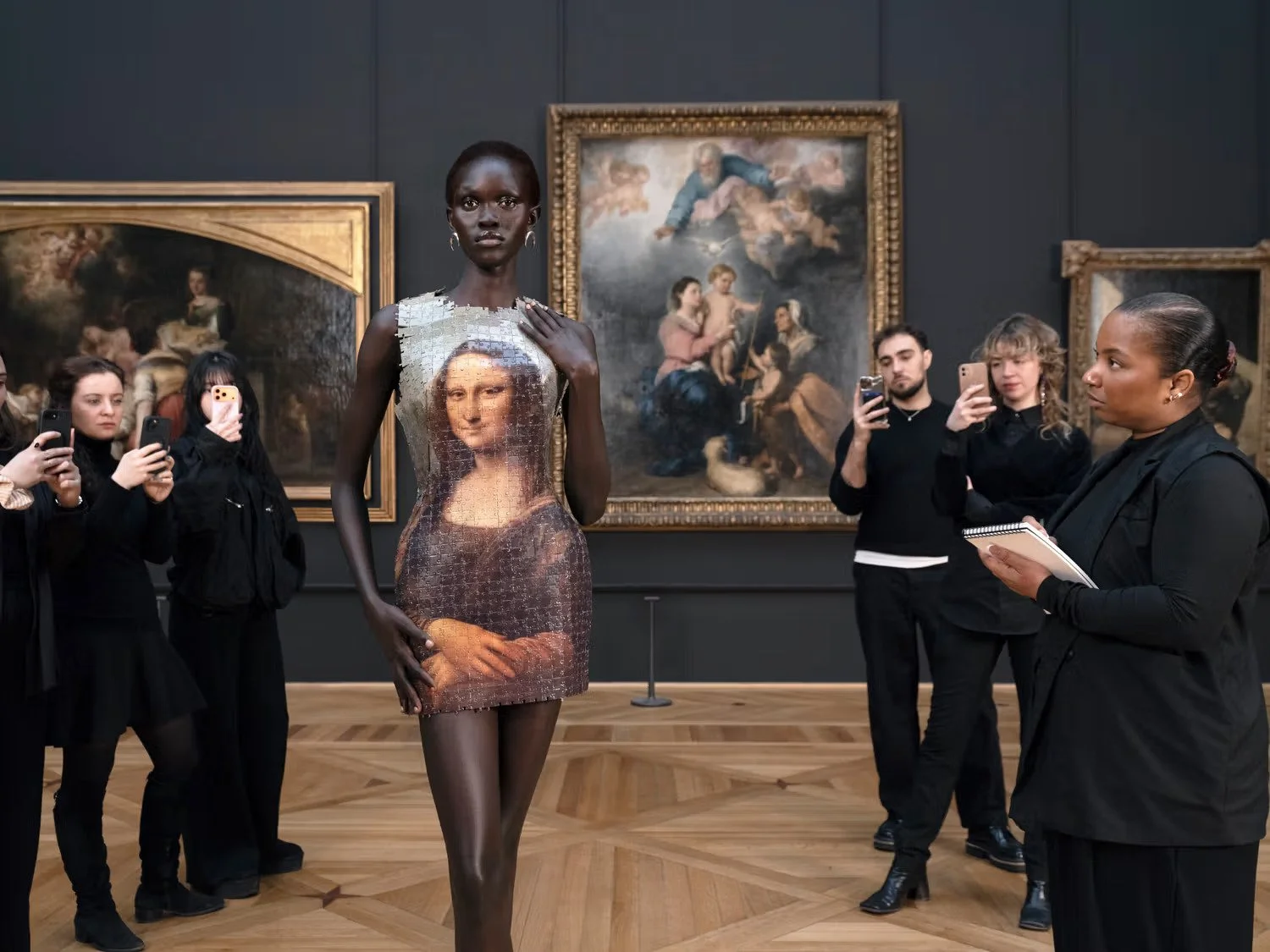
Look 01: La Joconde Dress
The La Joconde Dress required 420 hours of work, positioning the Mona Lisa not as an untouchable museum icon, but as a fragmented image reactivated across the body. Rather than simply reproducing Leonardo da Vinci’s masterpiece, Marine Serre treats it as a visual code to be reconstructed. The dress turns one of the most recognizable faces in art history into a moving composition, shifting the image from frame to form.
Here, La Joconde becomes less a portrait than a living archive. The body interrupts the stillness of the museum image. History is no longer fixed behind glass; it moves, bends and breathes.
Look 02: Embroidered Mesh Dress with Brushes
Taking 390 hours to complete, the Embroidered Mesh Dress with Brushes turns the painter’s most familiar tool into couture architecture. Paintbrushes, usually associated with gesture and mark-making, are repurposed as sculptural elements within the garment itself.
The result challenges the boundary between tool and artwork. The brush is no longer outside the creation. It becomes part of it. Through this transformation, Marine Serre questions where artistic labour begins and ends, collapsing the distance between the painter’s studio and the fashion atelier.
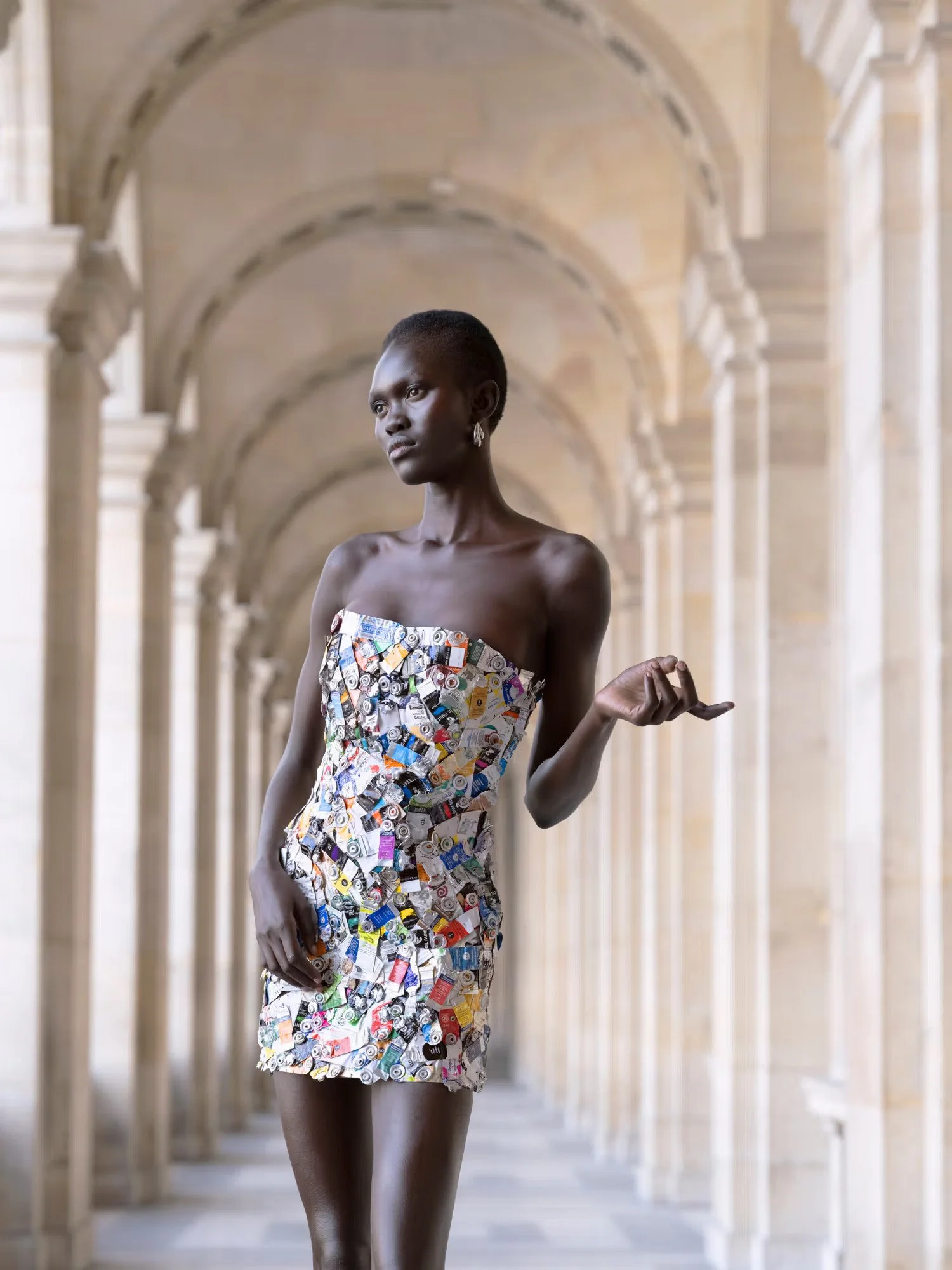
Look 03: Bustier Dress with Recycled Paint Tubes
The Bustier Dress with Recycled Paint Tubes, completed over 240 hours, brings Serre’s regenerative philosophy into sharp focus. Paint tubes, objects typically emptied, squeezed and discarded, are recast as couture material.
This look feels especially connected to the designer’s long-standing commitment to reuse and transformation. What might be considered waste becomes structure. What once held pigment becomes ornament, armour and memory. The dress carries the residue of artistic production while transforming it into a new luxury language.
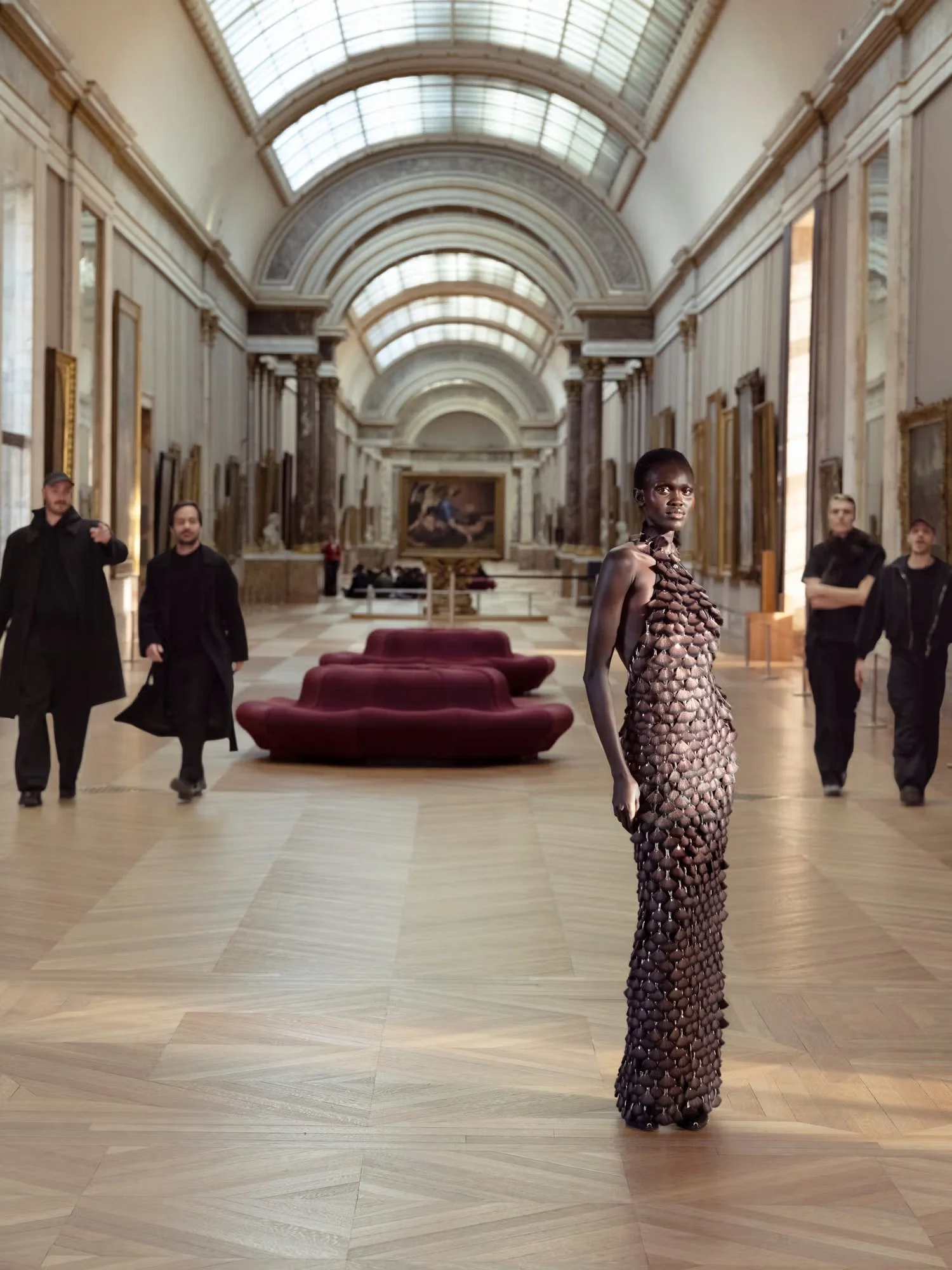
Look 04: Time Armor Dress
The Time Armor Dress required 250 hours of work and introduces a more protective, sculptural energy into the collaboration. The title itself suggests a garment built not only from material, but from duration. Time becomes something that can be worn, layered and defended.
In this look, Marine Serre appears to treat history as both weight and protection. The past is not soft decoration; it becomes armour. The silhouette speaks to the endurance of cultural memory and to the possibility of carrying history without being trapped by it.
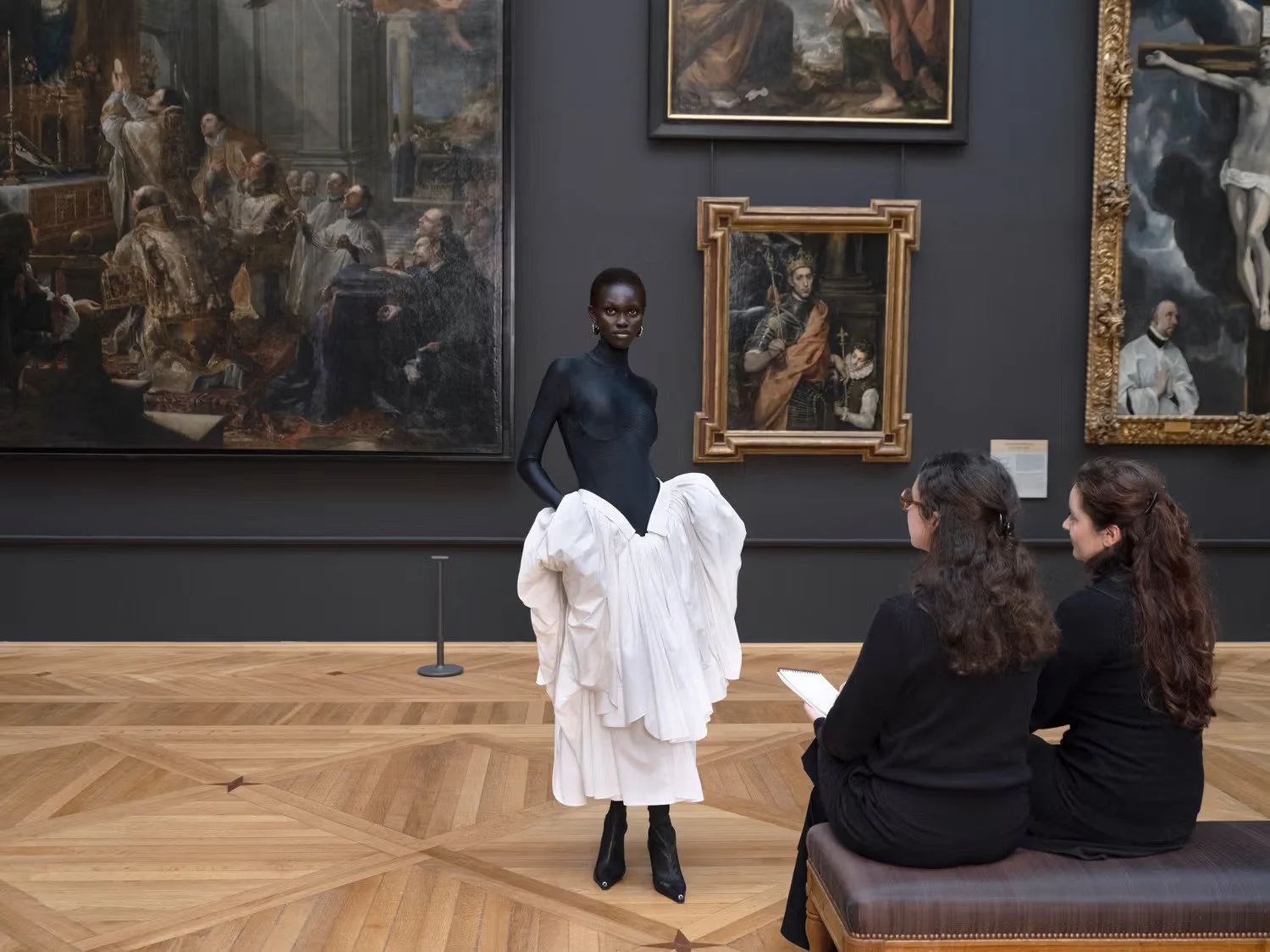
Look 05: Flemish Painters Dress
The Flemish Painters Dress, created over 84 hours, brings another art historical language into the project. Flemish painting is associated with texture, light, domestic detail and an almost obsessive attention to surface. Marine Serre translates that world into garment form, allowing painterly references to become wearable atmosphere.
Compared to the more labour-intensive constructions in the series, this look feels direct yet layered. It completes the five-part conversation by expanding the collaboration beyond a single Louvre icon and into a broader meditation on painting, history and the body.
Couture as Reconstruction
What makes Marine Serre x Louvre compelling is that it does not treat fashion as an accessory to art. Nor does it reduce the museum to a backdrop. Instead, the project proposes couture as a method of interpretation. Each look becomes a way of reading history through material, labour and movement.
The garments function like living archives. They preserve, but they also disturb. They reference the past, but they refuse to leave it untouched. Through reconstruction, Marine Serre turns heritage into an active force rather than a closed chapter.
This is the deeper intelligence of the collaboration. It understands that museums are not only places of preservation. They are sites of continual reinterpretation. Every generation returns to the archive with new questions. Marine Serre’s question is distinctly contemporary: what happens when history is not only viewed, but worn?
The Louvre Through Marine Serre’s Future Vision
Marine Serre’s work has always existed between worlds: couture and sportswear, apocalypse and renewal, archive and street, luxury and reuse. The Louvre collaboration sharpens that tension. It places her regenerative design philosophy inside one of the most symbolically loaded spaces in Western art and allows the encounter to produce something unexpectedly alive.
The five looks are not costumes, and they are not simple tributes. They are propositions. They suggest that the future of couture may depend not on creating from nothing, but on re-seeing what already exists. A brush. A paint tube. A shirt. A masterpiece. A myth.
Through Marine Serre’s lens, these fragments become raw material for a new visual language. The museum becomes an atelier. The archive becomes a body. And the past, rather than remaining behind us, steps forward in couture form.
Marine Serre x Louvre is ultimately a study in transformation: of objects, images, symbols and histories. It reminds us that fashion, at its most powerful, does more than dress the present. It teaches the past how to move again.